Work Experience Abroad
Authentic language learning on a one-week work placements in France and Spain

Work Experience Abroad
Work Experience Abroad takes A-level, IB and Scottish Highers students aged 16–19 out of the classroom to use their language learning in the real world. From cafes to kindergartens, toy shops to tennis centres, our work placements immerse students in local language and culture in Spain and France.
Dealing with new and unexpected situations, thinking on your feet and solving problems without a dictionary – these are just some of the challenges you’ll face every day on your work experience placement abroad. They may seem a daunting at first, but no classroom can ever provide the opportunities for spontaneity, authenticity and discovery that students experience on a work placement.
Trips in April include homestay accommodation, while trips in July are based in hostels. All trips are led by a Group Leader who is fluent in the local language to support the students during their placements.
Book Your Trip

Work Experience in France
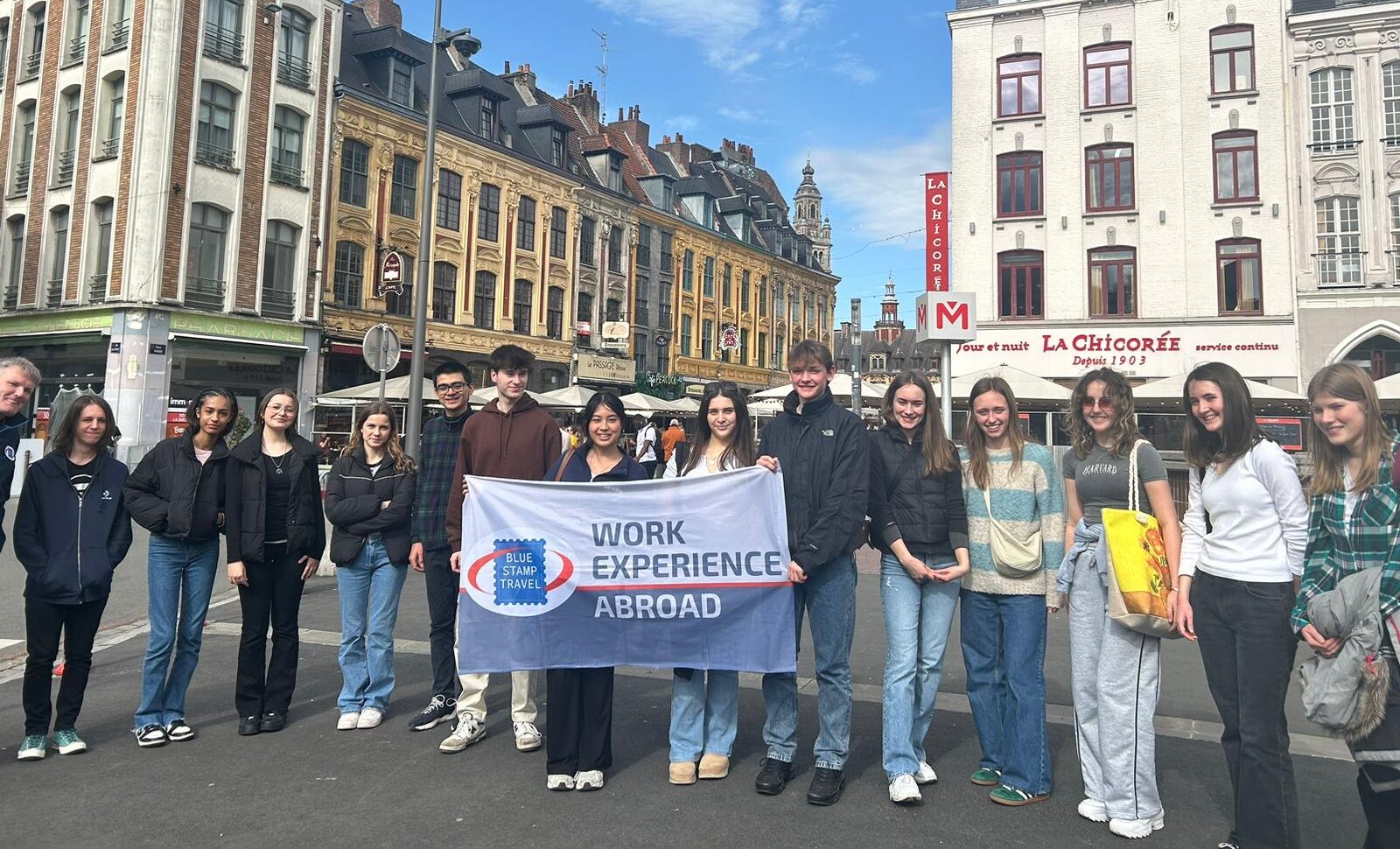
April 2027 | Lille | Homestay Accommodation
Sunday 04/04/27 to Saturday 10/04/27
July 2027 | Lille | Hostel Accommodation
Sunday 11/07/27 to Saturday 17/07/27
Travel by Eurostar from London St Pancras International to Lille Europe

Work Experience in Spain
April 2027 | Alicante | Host Accommodation
Saturday 03/04/27 to Friday 09/04/27
July 2027 | Alicante | Hostel Accommodation
Saturday 10/07/27 to Friday 16/07/27
Travel by air from London Luton to Alicante
Why Work Experience?
When learning a foreign language, structured learning in a classroom environment is vital to master grammar, vocabulary and subject knowledge across the domains of speaking, listening, reading and writing. However, using language in real life presents challenges that classroom learning can never replicate. What happens, for example, when you encounter a local dialect word that even your teacher would not know? How do you deal with a situation where you have no time to look up a word or refer to your notes?
In a work placement, be it working with children in a kindergarten, serving coffees in a noisy coffee shop, or handling enquiries in an office setting, students learn not how to be perfect, but how to get by. They learn how to think on their feet, to improvise and find solutions to problems in real time. They may have to dredge up scraps of vocabulary last learned years before, increasing the retrieval power of their learning, or develop strategies to cope with new and unfamiliar situations.
When we asked students for their feedback on their experiences, the word that comes up time and again is confidence. Tackling challenging situations gives students the self-belief to go further with their language learning, reassuring them that they really can use what they have learned in the real world.
In addition to this, students acquire invaluable transferable skills, such as teamwork, independence and resilience and adaptability. Regardless of the business category, students reported a positive impact on the skills they will need in higher education, training and their future careers.
Read our summary of the benefits of work experience or our detailed analysis of student feedback.
Student feedback from France
Student feedback from Spain
Work Experience Abroad FAQs
Our work experience mixes school trips are open to 16-19 year olds studying a foreign language for their AS Level, A Level, IB, Scottish Highers, Irish Leaving Certificate or similar.
Consideration will be given to students who have not yet started an A-level (or equivalent) in the target language, but who can demonstrate they are working at B1 level or above.
University students and mature students can book on to our tailor-made packages which can include language courses, Work and Study or Internships as well as homestay or hotel accommodation.
If you are a teacher wanting to take a class of students, we can arrange a tailor-made trip for your group organising transport, accommodation and language school and/or work placements for each of your students.
Work Experience Abroad is designed with A-level, IB and Highers students in mind. It is not suitable for GCSE students. In our experience, students at CEFR B1 level will be well equipped to make the most of the opportunity
Of course! Share the Plan Your Trip link with your friends to make sure you all enrol on the same course.
Yes!
Every trip we have many students who arrive independently and soon make new friends.
For many students, Work Experience Abroad is their first opportunity to travel independently of parents and their immediate school friends and classmates. While abroad, students get to experience independence in a safe and supported environment, making it great practice for going away to university.
Students can opt in to share their contact details via the Babel dashboard to connect with one another, share questions and discuss practicalities.
Our Group Leaders are trained in getting students to integrate and mix – students value the support of a trusted adult who can offer the advice and guidance they need
Under the supervision of an experienced and fully vetted Group Leader, Work Experience Abroad trips make a fantastic alternative to an A-level class trip, especially for small groups.
Your students enrol on the trip and we take care of everything else. Contact us and we’ll be happy to answer all your questions.
A typical Work Experience Abroad group numbers around 15 students.
When a student enrols on the trip, we ask them to provide information necessary to run the trip and keep them safe abroad. This includes:
- Full name
- Address
- Date of birth
- Passport information
- Medical conditions, allergies and dietary requirements
- Medical practice in the UK or home country
- Photograph (suitable for use in a professional setting)
- Contact details for at least one parent/carer
Practicalities
As the name suggests, Work Experience Abroad is all about work, so you will need clothes and shoes suitable for a professional setting. Your placement may specify what or what not to wear: please respect their requests.
In general, don’t takes holiday clothes for work placements, even if you are travelling in summer. You may be interacting with customers or working with children, for example, so your employer will expect sensible, appropriate clothing.
For everything else, have a look at our handy packing guide.
Work Experience Abroad is a great opportunity for students to learn how to budget and manage money independently. They should research in advance and plan their spending accordingly.
For homestay trips we recommend budgeting around €100 for the week to cover lunches, public transport and souvenirs.
For Work Experience Abroad trips with hotel accommodation we advise budgeting around €200 to cover the week’s expenditure on lunches, evening meals and public transport.
Before travelling, students should check for any additional fees or charges levied by their bank for spending abroad. Sometimes retailers may ask if you want to pay in pounds or euros: we always recommend paying in euros for the most competitive exchange rate.
We expect students to take a mobile phone with them while travelling – it’s a vital means for the Group Leader to contact them to ensure they are safe while travelling.
Read our detailed guide to mobile phones abroad.
Bookings and Payments
There is a limited number of places on each trip, so book as early as possible. Bookings may close when a trip is full.
All trips are subject to our standard Booking Conditions. Final payments are due 12 weeks prior to travel.
Late bookings may be accepted: contact us and we will be happy to advise you on your options. Late bookings may be subject to a surcharge to cover increased transport costs if prices have increased since the deadline.
Travel
Travel by air
We usually travel from London airports; generally Luton or Stansted, and less frequently from Gatwick or Heathrow. You will be informed of the departure airport several weeks prior to departure.
Travel by Eurostar
The meeting point for trips by Eurostar is in London St Pancras International train station.
You will receive details of the meeting point and time at your respective port of departure. Please allow plenty of time for your travel to the airport or St Pancras International and contact the Group Leader if you are delayed.
We understand that some students need to travel independently to join the group – due to other commitments, travel onwards after the trip or travelling from locations where it is impractical to meet the group at a port of departure close to London.
Wherever possible, we will accommodate all reasonable requests for independent travel. Give us a ring or send us a message and we will be happy to help.
We will ask that you send us the student’s travel details to assist the Group Leader in arranging for the student to meet the rest of the group in country.
Accommodation and Meals
Your account on Babel will show full details of your accommodation.
If your trip includes Homestay accommodation, details will be shared two to three weeks before the departure date.
Students on trips with host accommodation generally share in pairs or groups of three. If they are travelling with friends, there is the opportunity to request to share with another student.
At the time of application, if you wish to, you can tell us the name of any particular friend with whom you would like to share.
We will accommodate any reasonable request as far as possible, depending on availability and other factors.
Please note that in line with best practice guidance from the British Council, we do not permit mixed genders to share the same host accommodation.
Some hosts have pets. If you prefer not to stay in a homestay with pets please let us know via your application.
Rooms are normally, twin, triple or four-bed. If you’re travelling with a friend and want to share a room with them, please let us know in advance.
Blue Stamp Travel follows UK government guidance on student gender in shared accommodation.
Work Experience Abroad trips in homestay accommodation are offered on a half-board basis, where breakfast and evening meals are taken at the host’s home. The Group Leader will organise one group evening meal towards the end of the week for the students to socialise, receive certificates and reflect on their experiences. Students will need to budget for all lunches during their stay.
Work Experience Abroad trips in hotel accommodation are offered on a bed and breakfast basis, with two group evening meals included in the price. Students will need to budget for all lunches and other evening meals. Our experienced Group Leaders will recommend affordable local restaurants where students can eat together, or students can explore the many different options available in the destination city.
Work Placements
When a student enrols, we ask them to select five business categories, ranking them in order of preference. We also ask for information about their prior work experience and future academic and professional goals. Based on this information, our experienced Placement Coordinator matches each student to the most suitable placement available at the time of the trip.
We ask that students bear in mind it may not always be possible to give them their first choice business category. In some cases, our knowledge of placements in a destination may mean a student is placed in a lower preference category where the Placement Coordinator is confident that the nature of the workplace is a better fit for the student overall.
Before travelling, each student is asked to upload a short letter introducing themselves to their future work placement. The letter should be written as early as possible, as the information it contains provides useful context for the Placement Coordinator when matching students to placements.
The letter should introduce the student, describe their prior work experience, academic achievements and future academic and professional goals. It should also explain what the student hopes to achieve through their work placement.
In our experience, 200 words is a reasonable guideline for the length of the letter, which should be written formally and with attention to correct grammar and vocabulary. That said, we advise against using AI tools to draft or proofread the letter, as these can give a misleading impression of the student’s language skills and possibly lead to misunderstandings when they start their placement.
Allergies and Dietary Requirements
Where small adjustments are needed such as avoiding strawberries for a mild allergy reasons or avoiding certain foods out of preference (like brussels sprouts, for example), you can simply inform us on your application and we will make sure that the host knows to avoid these foods during your stay.
Vegetarian, Vegan, Halal, Gluten Free and other specific diets can usually be accommodated. In some locations there may be a charge for a special diet to be provided. Please let us know of any requirements early in your application.
Different cultures and countries may have different understandings of and attitudes towards dietary preferences that are common in the UK. Please be mindful that some flexibility may be needed – although no students are ever expected to eat anything that they would not choose to eat.
If you have a more severe allergy please let us know through your application. It is important we know this as soon as possible so that we can allocate hosts appropriately.
Where slight adjustments to the food served are needed these can usually be made in most families. If more significant changes are needed we may seek a specific host who can cater for your needs.
If you carry an epi-pen (or similar) for allergies, we will inform your host in advance if you are staying with in a homestay.
Supervision
A Group Leader accompanies the trip. They are usually language teachers, native speakers or linguists with a degree or relevant experience abroad.
Group Leaders offer guidance and support where needed to ensure students get the most out of their placements. If students are encountering difficulties at work, the Group Leader is there to support them – as fluent language speakers, Group Leaders can resolve almost all problems immediately. They also work with students to ensure they are abiding by curfews, behaving safely and sensibly, and upholding the standards expected of them in their work placements.
Group Leaders are responsible for ensuring that students adhere to the code of conduct and have a safe and enjoyable trip. They also provide social opportunities and visit the work placements. They are the first port of call for students on the trip. As with all Blue Stamp Travel trips, students and parents/carers can access 24/7 emergency support from our UK office.
The Code of Conduct is part of the application process. It is an agreement that we ask students and parents/carers to sign in order to make clear the expectations of student behaviour on these trips. In general, students are keen to get the most out of the trip and this is best achieved when following the simple rules.
The Code of Conduct reads:
The Group Leaders will be responsible for the organisation of your trip whilst abroad and students should comply with all reasonable requests made by them.
General
- All students will be treated as young adults and should behave appropriately.
- Do not go out at night on your own and always sign in/out at the accommodation.
- Treat others with courtesy and politeness.
- Do not take any illegal substances.
- Refrain from consuming excess alcohol.
- Be prompt for all meetings and particularly coach and flight departure times.
- Take any worries or concerns about any aspect of the trip to the Group Leaders.
- Work
- Attend the full number of sessions planned.
- Seek written approval from a Group Leader in the case of any absence from work.
- In the event of any difficulties at work, in the first instance, seek advice from the Group Leaders to resolve the situation.
- Refrain from using smart phones/tablets in the work place unless instructed by employer.
Accommodation
- Respect others in the accommodation by conforming to curfew, quiet times and lights out times.
- Do not keep food or alcohol in rooms.
- Keep rooms tidy.
- Do not allow non-residents into student rooms.
- Respect the accommodation and report any damage as soon as practicable.
I acknowledge receipt of the Code of Conduct and agree to abide by it. I accept that in the event of any misconduct or breach of the Code of Conduct, I may be required to reimburse costs incurred. In the event of a serious misdemeanour my parent(s)/carer(s) may be informed and in the most serious of cases I may be repatriated and expected to meet these costs.